

DeepSeek V4 Pro and Grok 4.6 Enter a New AI Arms Race Over Agents and Cost
DeepSeek and xAI are turning the latest frontier-model race into a battle over autonomous agents, engineering performance and, perhaps most importantly, price.
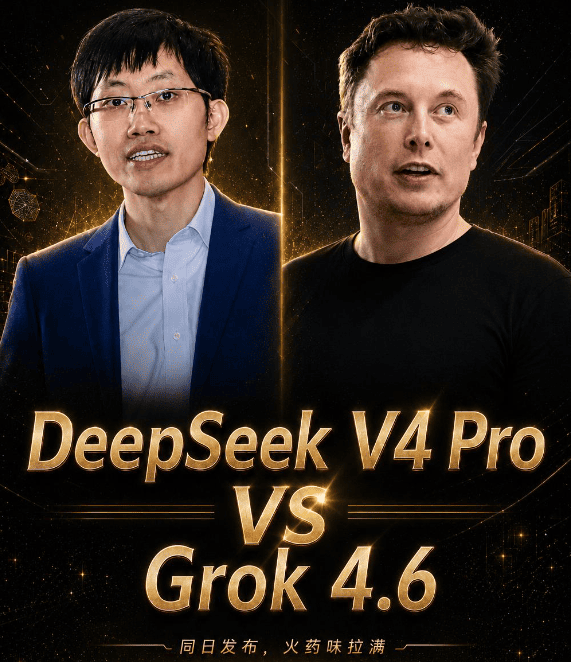
The latest round of competition in the AI industry has taken a dramatic turn, with Chinese AI startup DeepSeek launching the production version of DeepSeek V4 Pro while Elon Musk’s xAI rolled out its latest flagship, Grok 4.6, around the same time.
Rather than focusing solely on traditional chatbot benchmarks, both companies are increasingly positioning their models around a more ambitious goal: long-running AI agents capable of planning, using tools, debugging problems and completing complex tasks with limited human supervision.
At the same time, both releases are putting pressure on one of the AI industry's long-standing assumptions — that frontier-level intelligence inevitably comes with frontier-level prices.
From Chatbots to Autonomous Work
The most important shift in this latest model race is not simply another jump in benchmark scores. It is a change in what researchers and developers are asking AI systems to do.
The industry is moving beyond short conversations and code completion toward systems that can operate inside real environments, call external tools, identify failures, modify their own work and ultimately deliver a functioning result.
DeepSeek V4 Pro has placed particular emphasis on agentic coding and engineering tasks. DeepSeek says the model supports tool calling and a 1-million-token context window, while its official API lists output pricing at just $0.87 per million tokens.
Reported benchmark results also point to significant gains in agentic coding. In the tests cited in the original report, V4 Pro scored 87.9 on Terminal-Bench 2.1, narrowly behind Claude Fable 5 at 88.0, while its DeepSWE coding-agent score rose from 12.8 during the preview period to 62.7.
Grok 4.6 is taking a similar approach from the other side of the market.
The model is designed for longer-running tasks and has been positioned as a more capable and cost-efficient alternative to the most expensive frontier systems. Recent reports put Grok 4.6 at $6 per million output tokens, while its performance on several intelligence and coding evaluations has placed it in the same broad competitive tier as OpenAI's GPT-5.6 Sol.
OpenAI itself describes GPT-5.6 as a model built for complex coding, knowledge work, cybersecurity, science, computer use and design, with an emphasis on getting more useful work from each token.
The result is a changing definition of what “frontier AI” means. The question is increasingly not whether a model can answer a difficult question, but whether it can finish the job.
The Price War May Be Even More Important Than the Benchmark War
Performance numbers attract attention, but pricing could have the bigger impact on the industry.
DeepSeek V4 Pro's official API pricing is currently $0.87 per million output tokens. By comparison, Grok 4.6 has been reported at $6, GPT-5.6 Sol at $30, and Anthropic's Claude Fable 5 at $50 per million output tokens.
| Model | Output price per 1M tokens |
|---|---|
| DeepSeek V4 Pro | $0.87 |
| Grok 4.6 | $6.00 |
| GPT-5.6 Sol | $30.00 |
| Claude Fable 5 | $50.00 |
At those rates, the difference is no longer marginal.
DeepSeek's output pricing is roughly one-seventh of Grok 4.6's, around one-thirty-fifth of GPT-5.6 Sol's, and less than two percent of Fable 5's listed output price.
That gap matters because autonomous agents can consume far more tokens than conventional chatbot interactions. An agent may spend hundreds or thousands of model calls planning, searching, writing code, testing it and correcting mistakes before completing a single task.
Lower token costs therefore have the potential to change the economics of deploying agents at scale.
There is, however, an important caveat: API pricing can change quickly as demand, infrastructure costs and model availability evolve. DeepSeek has already announced a new V4 pricing structure that will take effect on August 17, with both peak and off-peak rates.
Real-World Coding Tests Tell a More Complicated Story
Benchmark scores only tell part of the story.
In practical “vibe coding” and frontend-generation tests cited in the original report, DeepSeek V4 Pro performed strongly on tasks such as generating a 3D interactive globe, a large Bento-style interface and a playable 3D Breakout game.
The model was also reported to perform particularly well on smaller game-development tasks. In one Flappy Bird comparison, DeepSeek reportedly produced a more detailed result while using significantly fewer tokens and costing roughly $0.019 for the task.
That does not mean DeepSeek consistently wins every real-world test.
More demanding rendering and physics tasks can still expose differences between models. In tests involving Three.js scenes and other visually complex workloads, GPT-5.6 and Claude's flagship models retained advantages in certain areas.
DeepSeek also showed occasional small but noticeable errors — including mistakes in motion or object orientation that would be easy for a human developer to spot but could matter in production environments.
That distinction is important. The frontier-model race is no longer simply about whether an AI can generate something impressive once. It is about whether it can repeatedly produce reliable results with minimal supervision.
AI's Cost Curve Is Falling — and Agents May Be the Biggest Beneficiary
The significance of the DeepSeek and Grok releases goes beyond two competing models.
The broader trend is clear: frontier AI companies are increasingly competing not only on raw intelligence, but on intelligence per dollar.
Anthropic's Claude Fable 5, for example, is explicitly designed for long-running coding and knowledge-work tasks, with the company saying it can plan across multiple stages, delegate to sub-agents and check its own work.
OpenAI is pursuing a similar direction with GPT-5.6's multi-agent capabilities, while DeepSeek has built V4 around long context, tool use and agentic coding.
Meanwhile, xAI has already signaled that the Grok lineup will continue to move forward, with a more powerful Grok 4.7 reportedly in development.
If the cost of running sophisticated agents continues to fall while their reliability improves, the implications could be substantial.
AI coding assistants, automated software maintenance, research agents, data-analysis systems and other forms of AI-powered knowledge work could become economically viable at a scale that was difficult to justify only a year or two ago.
The old equation — more intelligence means higher cost — is being challenged from multiple directions.
And as DeepSeek and Grok have now demonstrated, the next major AI battle may not be about which model can answer the hardest question.
It may be about which model can get the most work done for the least money.
Source: Xinzhiyuan
For more technology and AI news, stay tuned to Huading Network.
If there are any copyright concerns regarding this article, please contact us for prompt removal.